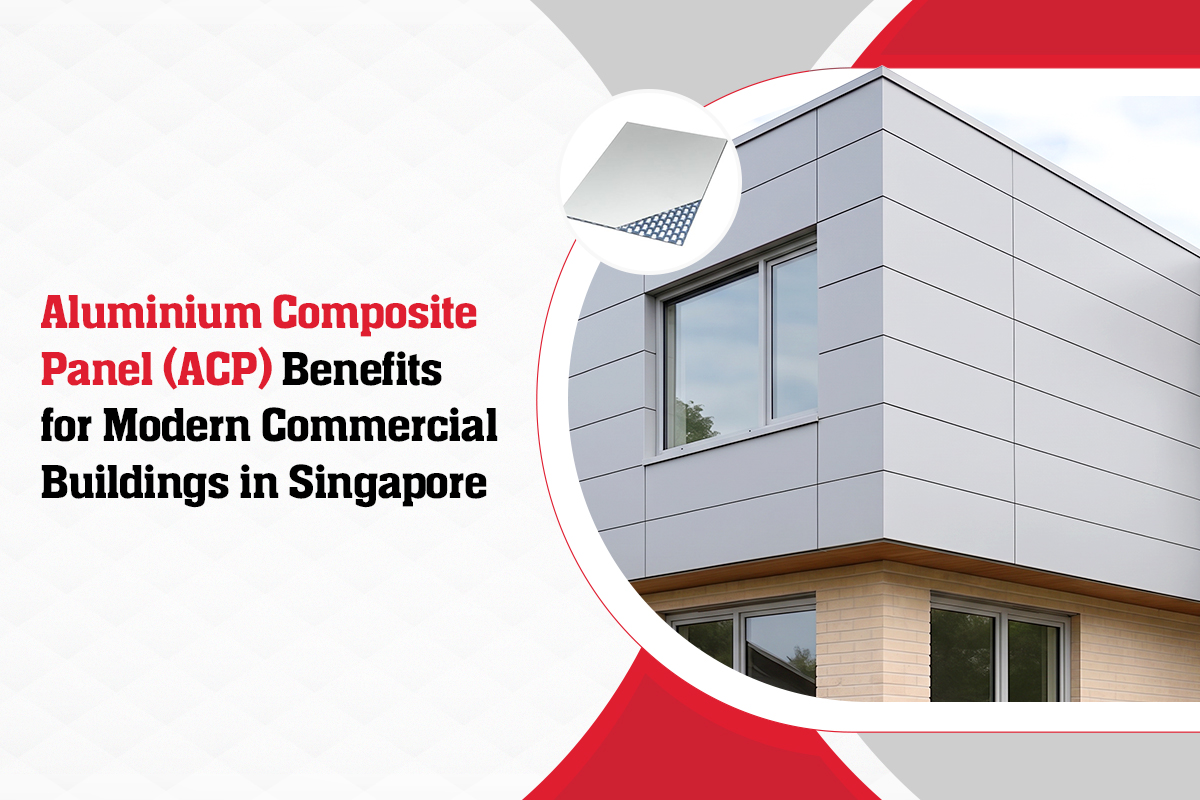
Take a stroll through the commercial parts of Singapore, and you will see just how many new buildings have the same clean look: flat, smooth surfaces in bright or muted tones that remain unmarked even in Singapore’s climate. There are few things more responsible for that look than the aluminium composite panel. This façade material is widely used across office, commercial and institutional developments in Singapore. With two thin aluminium layers glued together with a core between them, an aluminium composite panel is strong and highly adaptable. This is what makes it suitable for use in modern commercial buildings, and some things to consider before using it.
Lightweight Strength of Aluminium Composite Panel That Simplifies Construction
An aluminium composite panel offers strength despite its lightness. Since the material applies much lower loading onto the structure compared to precast concrete, stone, or a solid metal plate, supporting structures and foundations can be lighter. Panels are moved by installation workers without using heavy lifting machinery, making it possible to reduce programmes in urban areas with a tight schedule for crane deployment and road closures. For high-rise recladding work, this ease of handling often decides the entire construction methodology.
Fire Performance That Meets Modern Regulations
Fire safety on facades has certainly been under very strict global scrutiny, and those of Singapore are among the most stringent. Claddings with mineral cores that resist fire, or honeycomb structures that do not burn when put through BS EN 13501-1:2018 testing, have become the new standard. When evaluating any ACP panel Singapore suppliers offer, ask for the classification certificate rather than accepting a brochure claim. Class A2 or equivalent performance separates products genuinely engineered for building envelopes from commodity sheets intended for signage.
Design Freedom for Distinctive Architecture
Aluminium Composite Panels offers architects considerable design freedom. The panels may be cut and made into cassettes, shaped around columns, punched for screening or offered in metallic, solid, or wooden effects from a wide range of colour schemes. The superior surface flatness results in a sleek, monolithic look that characterises modern-day commercial design. The same system is applied within buildings as feature walls, column coverings, and ceiling components, allowing one material to unify the development through its visual identity both outdoors and indoors.
Weather Resistance Built for the Tropics
The harsh rays of the sun and the moisture content in Singapore make poor paintwork very challenging. High-grade façade panels always have a coating of paint that is mainly made up of PVDF, and a suitable PVDF coating can help retain the panel’s colour and finish over time. The aluminium material cannot corrode, and since the panel joints are all sealed, moisture cannot penetrate the building envelope. In conclusion, the façade will look the same as in the render after ten years.
Practical Benefits Owners Appreciate
Beyond appearance and compliance, an ACP facade earns its keep operationally. The table below summarises the advantages that matter most to commercial building owners:
| Benefit | What It Means for Your Building |
| Low maintenance | Smooth surfaces clean easily; no repainting cycles |
| Thermal comfort | Reflective finishes reduce solar heat gain |
| Acoustic damping | Composite construction softens external noise |
| Recyclability | Aluminium skins and honeycomb cores are fully recyclable |
| Fast replacement | Individual panels can be swapped without disturbing the facade |
Matching Panel Types to Applications
Not every panel suits every location. Fire rating, core type and finish should follow the application:
| Application | Recommended Panel Type | Key Requirement |
| External facade cladding | Fire-retardant mineral core ACP | BS EN 13501-1 Class A2 |
| High-stiffness feature zones | Honeycomb core panel | Structural rigidity, non-combustible |
| Shopfronts and column cladding | Standard FR core ACP | Flatness and finish quality |
| Selective roofing elements | FR core ACP | Weather-resistant coating |
| Interior walls and ceilings | FR core or honeycomb | Aesthetics, easy cleaning |
Specifying this way keeps budgets efficient while ensuring the demanding zones receive the highest-performing product. Reliable aluminium wall cladding is always the product of matching, never of a one-size-fits-all purchase.
At LCP Building Products, we manufacture the LCP LYCORCLAD® Series, comprising FR CORE, FR HCOM and FR PRO, engineered for building envelopes that demand fire resistance, aesthetics and design flexibility in equal measure. LYCORCLAD® FR CORE achieves Class A2 fire behaviour in accordance with BS EN 13501-1:2018; our FR HCOM combines a non-combustible hexagonal honeycomb core with light weight, high rigidity and full recyclability, while FR PRO sandwiches a mineral-filled core between weather-resistant coated aluminium sheets. Proven on Singapore projects such as West View @ Bukit Batok and the Fu Lu Shou Complex, and backed by more than 30 years of manufacturing experience, supported by ISO 9001:2015, ISO 14001:2015 and ISO 45001:2018 certifications and a comprehensive colour chart, our panels serve commercial, residential, industrial and institutional developments across Singapore, South East Asia and beyond. Speak to our team to specify the right LYCORCLAD® system for your facade.
This aluminium composite panel is now crucial to the architecture of modern commercial buildings in Singapore due to the many benefits it provides, including
- Being lightweight but rigid.
- Being fire-resistant when the right specifications are used.
- Being versatile in design, and having durability in tropical conditions with minimal maintenance.
Determine what class of fire safety you need, choose the cores for the appropriate uses, and procure it from an experienced manufacturer with certified data. If you do, then your façade will pay back the effort for many years to come.