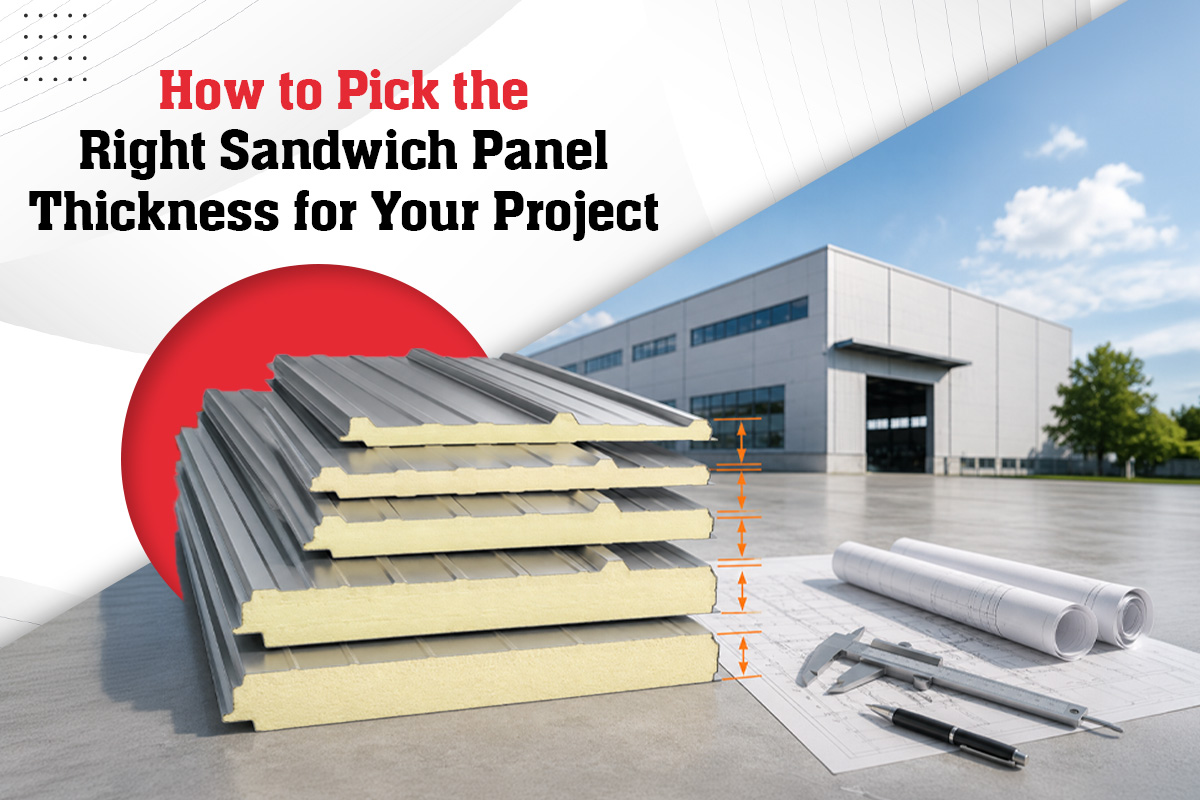
Selecting the right sandwich panel for your building is not always a matter of cost and colour only. The thickness of the panel core can significantly affect thermal performance, sound insulation and fire safety over the building’s service life. If you are selecting a roofing sandwich panel for your logistics warehouse or walls for your cold room, then choosing the proper thickness from the very beginning will help you avoid any mistakes. Let us take a look at how to achieve this systematically.
Understand What Sandwich Panel Thickness Actually Controls
The panel is composed of two sheets of metal attached to an insulation core such as PIR, PUR, mineral wool, and EPS. When it comes to the term thickness, this usually refers to the core itself, which is usually within the range of 30mm to 200mm. Thicker cores mean higher insulation capabilities, acoustic absorption abilities, and, most likely, better spans between purlins or other structures. However, thicker panels would also mean more expensive materials, heavier lifting, and larger structural considerations. The objective is not to select the thickest panel, but the one that best meets your project’s performance requirements
Start with Thermal Performance Requirements
Insulation will be one of the main reasons for the thickness requirement. In tropical areas such as Singapore and Southeast Asia, the aim is to keep the heat from the sun away and reduce the load on the air conditioning system.
50–75 mm | Warehouses and industrial buildings |
75–100 mm | Commercial and air-conditioned facilities |
100–150 mm | Cold rooms and chilled storage |
150–200 mm | Freezer rooms and temperature-controlled environments |
Factor in Fire Safety Early
Never neglect fire rating. A fireproof sandwich panel with a mineral wool or PIR core can provide higher levels of fire resistance than an EPS-core panel, depending on the specific product construction and certification, and in some places, there is a requirement for non-combustible or limited-combustibility core in particular occupancies.
When specifying a fireproof sandwich panel, verify:
- Required fire resistance rating
- Core material (PIR or mineral wool)
- Local building code compliance
- Insurance requirements
- Certified fire test reports
Match Thickness to Structural Spans and Loads
Panels are part of the structure, not just the cladding. With a thicker core, the panel will be stiffer and therefore able to span farther between supporting members without deflection. If you are designing with wide-spaced purlins in order to use less steel, then a thick roofing sandwich panel may allow for such spans within your designs. Roof panels that need to withstand the conditions of the monsoon season should also be considered capable of supporting heavier loads from rain and winds, so always cross-check the manufacturer’s load-span tables against your structural engineer’s calculations rather than relying on rules of thumb.
When selecting roof panels, appearance should also be considered alongside structural performance. Roofing sheets are available in a wide selection of factory-finished colours to complement different architectural styles and corporate branding requirements. Neutral shades such as White, Off White, Silver Grey, Smoke Grey and Charcoal remain popular for commercial and industrial developments, while custom colours can also be specified for projects seeking a distinctive visual identity.
Which Thickness Is Right for Your Project?
If your project is… | Consider |
Standard warehouse | 50–75 mm |
Office building | 75–100 mm |
Cold room | 100–150 mm |
Freezer | 150–200 mm |
High fire-risk facility | Fire-rated PIR or mineral wool panel |
Consider Acoustics, Condensation and Building Use
Apart from insulation and fire resistance, the thickness of the core is also important for comfort. A thick core provides better sound insulation and is vital for buildings that are located near airports, highways, and industries. Adequate panel thickness also helps minimise condensation by keeping the inner panel surface above the dew point under suitable operating conditions.
It’s essential to consider how the building will be used: a storage shed has very different requirements than a pharmaceutical company, a data centre, or a food processing plant with washdown and hygiene requirements.
Know When a Different System Suits Better
Not every application needs an insulated panel. For facades, feature walls and signage zones, an aluminium composite panel offers a lightweight, flat and highly formable alternative where insulation is secondary to aesthetics. LCP Building Products offers the LYCORCLAD® Series, designed to suit different fire performance and design requirements.
The range includes LYCORCLAD® FR CORE, featuring a mineral-filled core for enhanced fire performance, LYCORCLAD® FR HCOM, which incorporates a non-combustible aluminium honeycomb core for lightweight strength and recyclability, and LYCORCLAD® FR PRO, engineered with a mineral-filled core between weather-resistant coated aluminium sheets for durable architectural applications.
Sandwich Panel Thickness Selection Checklist
✔ Required U-value determined
✔ Fire rating confirmed
✔ Structural spans verified
✔ Acoustic requirements considered
✔ Condensation risk assessed
✔ Manufacturer’s technical data reviewed
Get Expert Input Before You Specify
Lastly, engage your supplier early. A credible sandwich panel manufacturer in Singapore will analyse your design, climatic conditions, fire code requirements, and span needs, and then advise you on which type and thickness of core to use based on proven and certified figures. Request load span tables, fire test results, and thermal performance certificates, and be sceptical of a supplier that gives you thickness figures without inquiring about your needs first.
Ask your supplier for:
- Load-span tables
- Thermal performance certificates
- Fire test certifications
- Installation recommendations
- Warranty information
At LCP Building Products, we provide complete façade and roofing solutions for commercial, industrial, institutional and residential projects. Our LYCORCLAD® Series has been developed to meet varying project requirements for fire performance, durability and architectural aesthetics. The range includes LYCORCLAD® FR CORE, LYCORCLAD® FR HCOM and LYCORCLAD® FR PRO, allowing architects and consultants to select a solution based on the specific performance needs of each project.
Selecting appropriate thickness of sandwich panel is a matter of compromising between thermal objectives, fire safety, span lengths, acoustics and budget of the particular building. First, establish your performance criteria, check them with certified test results, and turn to an experienced manufacturer for advice. Taking this approach will help ensure your building performs efficiently, safely and reliably throughout its service life.