
What actually holds a concrete floor in place while it cures, forty storeys up, before the slab can support itself? Most people walking through a finished tower never think about it, yet the answer decides how fast, how safely and how cost-effectively that building went up in the first place.
Metal deck formwork solves exactly this problem for modern high-rise construction, and it’s one of the least visible but most essential components of any tall building project. Suspended concrete slabs are a major time and cost factor in high-rise construction, and the formwork system chosen shapes nearly everything about how efficiently that slab gets built.
What Is Metal Deck Formwork and Why Does It Matter?
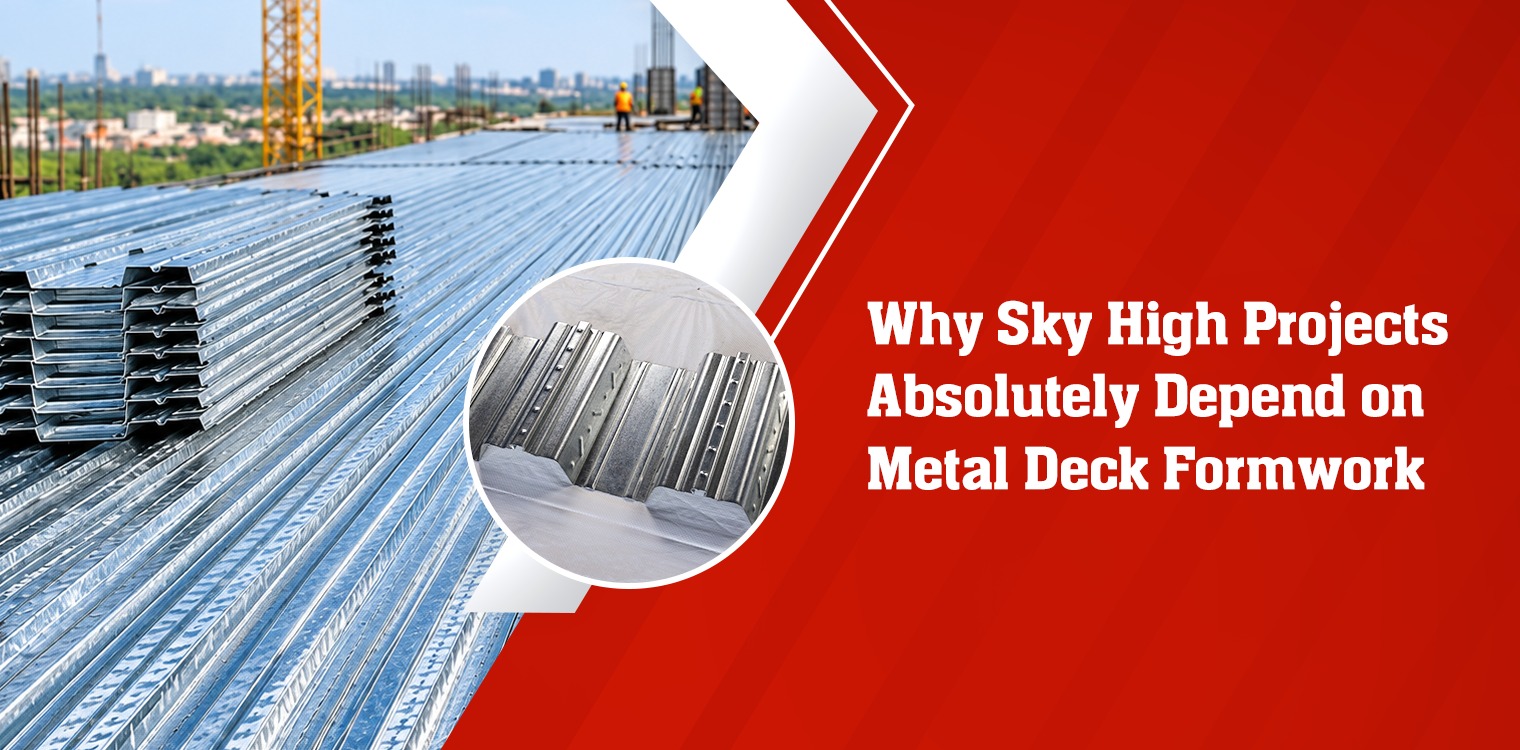
Metal deck formwork is a steel decking system that serves as both the mould for wet concrete and, in many cases, permanent reinforcement once the slab cures. Rather than building and later removing timber formwork for every floor, a steel deck stays in place, saving significant labour and material on repeated cycles.
For tall buildings, where every floor repeats the same construction sequence dozens of times, this efficiency compounds into real project-wide savings.
How Does LCP LYCORDECK® Work as a Total Formwork System?
LCP LYCORDECK® composite decking is designed to work as reinforcement and formwork combined, rather than as two separate systems bolted together. It suits floor slab construction across commercial, residential and industrial applications, and works in both steel frame and concrete frame buildings, including band beam applications.
It has also been used successfully in post-tensioned slabs, and can serve as effective formwork even in conventional slab designs where a full composite system isn’t required.
Why Choose LCP FORMDEK® for Long Span Requirements?
Not every project needs propping underneath the slab while concrete cures, and this is where LCP FORMDEK® earns its place. As a permanent steel formwork system, one of its main advantages is long spanning capability, supporting concrete slabs without needing temporary props beneath.
For sky-high projects where every floor level needs clear working space below, removing the need for propping genuinely speeds up the construction sequence, since the next trade can start work sooner.
How Does a Steel Cold Form Profile Contribute to Structural Efficiency?
Beyond the deck itself, a steel cold form profile, like LCP’s purlins and wall girts, plays a supporting role in the wider structural system. Cold-formed steel purlins are recognised as efficient, economical members suitable across a wide range of building applications, offering high strength at relatively low weight.
LCP manufactures these using quality high-tensile galvanised steel, in addition to reliable LCP multideck systems, with a full range of section depths from 100mm to 350mm, a range LCP states is unmatched among comparable manufacturers in the region.
What Makes Structural Building Products Genuinely Reliable for High-Rise Work?
Reliable structural building products for tall buildings share a few common qualities worth checking before specifying them:
- Consistent manufacturing quality across every batch, not just a sample
- Documented span performance backed by real product literature and BIM files
- Compatibility with both steel frame and concrete frame construction methods
- A track record across genuinely tall, demanding projects, not just low-rise work
LCP TOPHAT® structural top hat and batten sections add another layer to this system, suited to small and medium steel buildings, roof battens and ceiling applications, and built to resist burning, warping, rot and termite attack.
Why High-Rise Projects Depend on Metal Deck Formwork
Essentially, tall buildings are just the same floor construction sequence repeated many times over, so that even small efficiencies in formwork can lead to substantial savings in time and cost over the entire project. Products such as LYCORDECK composite decking, FORMDEK® permanent formwork and supporting steel members such as purlins and tophats are not isolated products, they are selected as part of a system.
LCP Building Products: Structural Systems Built for Height
At LCP Building Products, our structural range, including LCP LYCORDECK®, LCP FORMDEK®, LCP PURLINS & GIRTS® and LCP TOPHAT®, has supported high-rise construction across more than 900 projects in over 23 countries, backed by more than 30 years of manufacturing experience. We’re ISO 9001 certified since 2001 and BCA Singapore certified, and 94% of our clients return to us for their next project. If your next high-rise project needs a formwork and structural system built for genuine height and span, contact our team at lcp@lcp.sg or call (65) 6865-1550 to discuss the right combination for your building.
FAQs
What Is the Difference Between LCP LYCORDECK® and LCP FORMDEK®?
LYCORDECK® is a combined reinforcement and formwork in a total system, while FORMDEK® is a permanent formwork with long-span, no-propping capability.
How Does Metal Deck Formwork Reduce Construction Time?
It stays in place as part of the finished structure rather than being removed after curing, saving the labour and time otherwise spent building and stripping traditional formwork.
Why Do Tall Buildings Need Long Span Formwork Specifically?
Long span capability reduces the need for propping beneath each floor, allowing other trades to begin work sooner and keeping the construction sequence moving efficiently.
Best Steel Cold Form Profile for High Strength at Low Weight?
Cold-formed purlins and wall girts using high-tensile galvanised steel generally offer this combination, with deeper sections suited to longer spans.
Difference Between Structural Building Products for Low-Rise and High-Rise Work?
High-rise projects typically demand longer spans, documented performance data and systems proven across repeated floor cycles, requirements that matter less in smaller, low-rise buildings.
Disclaimer: This content is for general informational purposes only. Please confirm current product specifications with LCP Building Products before finalising your project design.