Every commercial or industrial building in Singapore faces the same three demands: keep the heat out, keep the fire risk down and get built fast. A sandwich panel Singapore project can meet all three with one product. Sandwich panels have a straightforward design: the product comprises two metallic skins attached to an insulated core.
What Is a Sandwich Panel and How Does It Work?
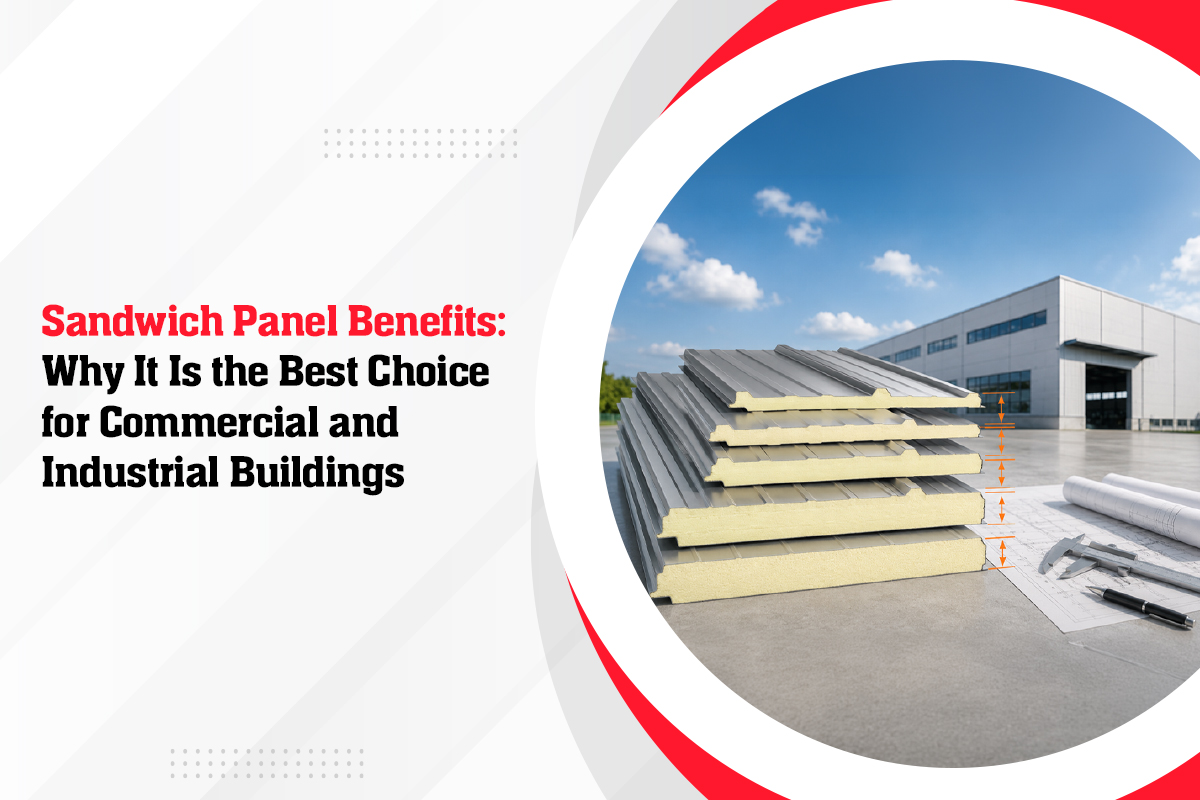
The structure should be visualised just as the name implies. The two metallic sides are the bread slices, while the centre, which is insulated using materials like PU, PIR, mineral wool, or a mineral-filled layer, is the stuffing. When they are combined, a more durable product is formed, where the skins provide protection from external elements and impacts, while the core helps reduce heat transfer and noise.
Because the panel arrives from the factory as one finished piece, a wall or roof goes up in a single step. There is no separate frame lining, insulation layer and outer sheet to install one after another. This is the main reason for most of the advantages listed here.
Key Benefits at a Glance
| Benefit | What It Means for Your Building |
| Thermal insulation | Colder interior and reduced cost of air conditioning |
| Fast installation | One panel covers three site activities |
| Fire performance | Fire-rated cores meet strict facade and factory rules |
| Light weight | Smaller structure, easier handling, lower cost |
| Clean finish | Factory coating inside and out, no painting needed |
| Low maintenance | Smooth surfaces that wash down easily |
Why It Suits Singapore’s Climate
Heat is the enemy here. A PU sandwich panel with good bonding in the core reduces heat transfer effectively, making it very efficient for air-conditioned spaces and comfortable for un-air-conditioned warehouses. The insulation also ensures that the inside surface of the panel stays above the dew point to control condensation.
Rain matters too. The panels are long with tightly fitting joints, giving little room for the monsoon rains to penetrate. This is in contrast to the many joints found in walls built up from multiple layers.
Where Each Panel Type Fits Best
Different buildings need different panels. Use this table as a starting point:
| Application | Recommended Panel | Key Requirement |
| Factory and warehouse roofs | Roof sandwich panel with PU or PIR core | Insulation plus watertightness |
| External walls and facades | Fire-rated insulated wall panel | Fire classification to BS EN 13501-1 |
| Cold rooms and food facilities | Thick-core insulated panel | Maximum thermal performance |
| Feature facades and entrances | Aluminium sandwich panel, mineral core | Flatness, finish and fire safety |
| Clean rooms and pharma | Smooth-faced insulated panel | Hygiene and easy cleaning |
Match the core, thickness and fire rating to the job, and the panel will repay you for decades. Force one product onto every surface, and you will overpay in some places and underperform in others.
Fire Safety: The Question to Ask First
Commercial and industrial buildings in Singapore have stringent fire regulations, and the material used plays an important role in determining the panel’s performance in case of a fire outbreak. It is important to always request the classified test result in line with BS EN 13501-1:2018. The mineral-filled or non-combustible panels have the potential to exceed ordinary foam core. If a supplier cannot show the certificate, move on. This one check protects your building, your insurance terms and the people inside.
Speed and Savings You Can Measure
Time is money on every site, and panels save plenty of both. A crew can fix large factory-finished panels in a fraction of the time a layered wall takes. Scaffolding comes down sooner. The building becomes weathertight earlier, so internal trades start sooner too. Add the lighter structure the panels allow, and the total project cost often lands well below a conventional build, even before counting years of lower energy bills.
At LCP Building Products, we manufacture the LCP LYCORCLAD® Series, our answer to projects that demand fire-safe, high-performance panels for building envelopes. LYCORCLAD® FR PRO is an aluminium sandwich panel with a mineral-filled core bonded between two weather-resistant coated aluminium sheets, while FR CORE achieves Class A2 fire behaviour in accordance with BS EN 13501-1:2018 and FR HCOM adds a non-combustible honeycomb core for zones that need extra stiffness. Proven on Singapore projects such as West View @ Bukit Batok and the Fu Lu Shou Complex, and backed by more than 30 years of manufacturing experience, supported by ISO 9001:2015, ISO 14001:2015 and ISO 45001:2018 certifications, and a minimum 10-year material warranty, our panels serve commercial, residential, industrial and institutional developments across Singapore, South East Asia and beyond. Speak to our team to find the right panel for your next project.
For any commercial or industrial structures, a Sandwich Panel Singapore product will ensure that what layering fails to provide is incorporated into a single manufactured unit. It all starts by selecting the right fire class, and then matching the core and thickness to each application. Buy only from a supplier with certified fire tests, and you will see savings in running costs for the entire lifetime of the building.